
A tooth can look perfectly normal from the outside while decay develops between teeth, bone levels change below the gumline, or a small area begins to shift from one visit to the next. That’s where advanced dental technology becomes useful. It gives us information that a mirror and visual exam alone can’t always provide.
At our Torrance office, we combine a careful clinical exam with digital x-rays, intraoral cameras, and 3D scanning. These tools don’t replace the dentist’s judgment, and they don’t automatically diagnose a problem. They give us a clearer picture so we can recognize changes sooner, explain what we’re seeing, and decide whether an area needs treatment or simply needs to be watched.
What advanced dental technology can help us see sooner
Different tools answer different questions. During preventive care, technology can help us:
- See decay or bone changes that aren’t visible during a regular visual exam
- Create detailed 3D records of teeth and gums
- Compare changes in your smile over time
- Magnify cracks, worn areas, gum changes, or suspicious spots with an intraoral camera
- Show you exactly what we’re concerned about before discussing treatment
The point isn’t to find more things to treat. It’s to have better information about what’s actually happening.
Digital x-rays reveal what a visual exam can miss
A dentist can learn a lot by looking directly at your teeth and gums, but some areas simply aren’t visible. Digital x-rays can help us evaluate what’s happening between teeth and beneath the surface, including hidden decay and changes in supporting bone.
The American Dental Association notes that dental radiographs help diagnose damage and disease that may not be visible during a regular examination. They’re particularly useful for conditions such as cavities between teeth and periodontal bone loss.
That doesn’t mean everyone needs the same x-rays on the same schedule. We consider your oral health, symptoms, history, and risk factors before deciding what imaging is appropriate.
A 3D scan gives us a record we can compare later
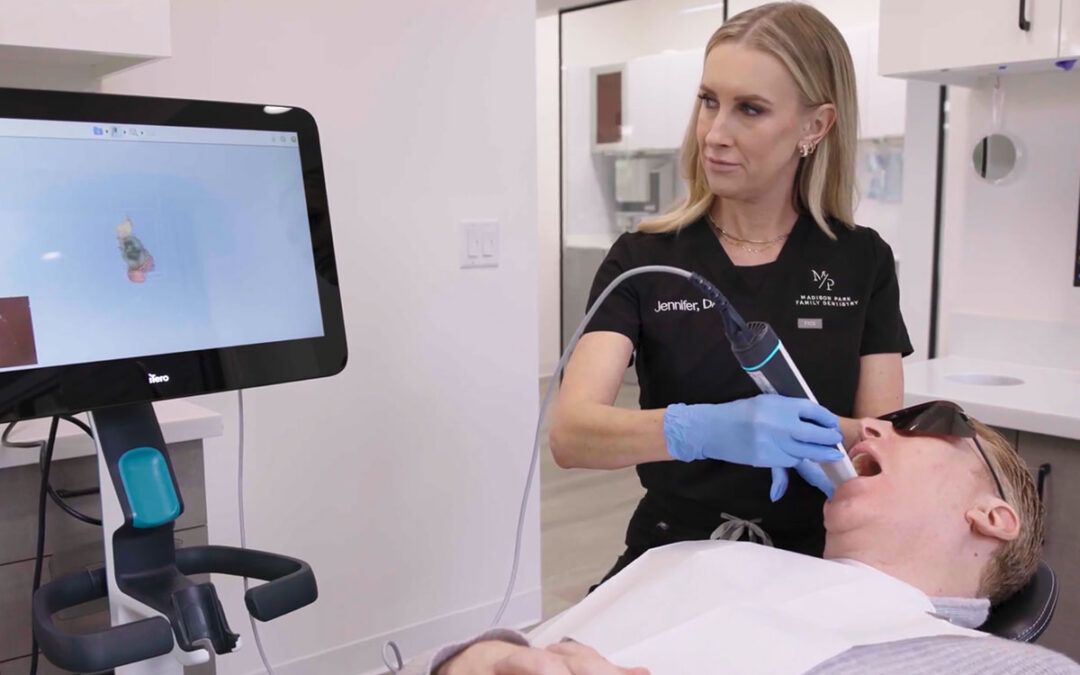
The iTero Lumina scanner creates a detailed three-dimensional image of your teeth and gums without traditional impression material. At Madison Park Family Dentistry, we use those digital records not only for treatment planning, but also to help monitor how your mouth changes over time.
That comparison can be valuable. A subtle shift, change in tooth position, or wear pattern may be difficult to appreciate from memory alone. Having a digital record gives us something concrete to compare at future appointments.
Importantly, the scanner isn’t making the diagnosis for us. It gives us another source of information to interpret alongside your exam and dental history.
Intraoral cameras make small details easier to see
An intraoral camera is exactly what it sounds like: a small camera that gives us a close-up view inside your mouth. It can make details around teeth and gums easier to examine while also putting the image on a screen where you can see it yourself.
That second part is useful. Instead of hearing, “There’s an area we’re concerned about,” you can often look at the same tooth or gum tissue with us. This is about giving patients more clarity around recommendations.
Seeing the issue doesn’t automatically mean treating it that day. Sometimes the right decision is to document the area and compare it later.
Early detection still starts with a good exam
Technology is only one part of preventive dentistry. A thoughtful exam still matters because your dentist decides what needs closer attention and which diagnostic tools are appropriate.
For example, current radiographic guidance recommends evaluating a patient clinically before deciding which x-rays are necessary. Your symptoms, cavity risk, gum health, previous dental work, and medical history all provide context for what appears on an image.
Our oral wellness checks combine visual screening with digital imaging and ongoing tracking. That gives us a more complete picture without pretending every unusual finding requires treatment.
Catching a small problem can open up more conservative options
A smaller problem can sometimes be managed differently from one that has already caused substantial damage.
Early-stage decay is a good example. Depending on what we find and the condition of the tooth, preventive care or a smaller restoration may be appropriate. If decay progresses and removes more healthy tooth structure, treatment can become more involved.
Our dental filling options include conservative approaches for different stages of tooth damage, and digital x-rays and intraoral cameras are part of identifying and showing those areas clearly.
Not every high-tech tool is designed to find disease
This distinction is easy to miss. Some of the most advanced tools in our office help with diagnosis, while others improve what happens after we’ve identified a problem.
Our Solea laser, for example, can treat many cavities and soft-tissue needs with less noise and often little or no anesthesia. The Glidewell Fastmill I.O. allows us to design and mill many crowns, inlays, and onlays in the office. Those tools can make treatment more efficient or comfortable, but they aren’t substitutes for the diagnostic process that tells us what needs treatment in the first place.
For patients in Torrance, the benefit is a connected workflow: better information first, then treatment technology when it’s actually needed.
Better visuals can make treatment recommendations easier to understand
Finding something early only helps if you understand what we found and what the options are.
Digital images give us a shared reference point. We can show you the tooth, compare records, explain what we’re monitoring, and discuss why we’re recommending treatment now or why we’re comfortable watching an area instead.
That fits our broader approach to care: it’s your mouth and your decision. Our job is to give you clear information, explain the options, and help you make an informed choice without pressure.
Preventive dental technology works best when we can track change
One image is useful. A series of exams and digital records can be even more informative because oral health changes over time.
At our Torrance practice, preventive visits give us opportunities to compare what we see today with what we documented previously. That can help distinguish something stable from something that’s progressing and needs attention.
If it’s been a while since your last exam, or you want a clearer picture of your current oral health, call (310) 953-3300 or schedule online. We’ll use the technology that makes sense for your needs and explain what we find along the way. Book your Torrance dental checkup.
Recent Comments